10 Best Junior Golf Clubs for Young Golfers
Choosing a junior golf club is not simply a smaller version of choosing an adult club. Young golfers need equipment that matches their height, strength, swing speed, and confidence.
Dan Van Horn, founder of U.S. Kids Golf, says, “The right clubs make the game more enjoyable for kids.” That principle guides this selection of the 10 Best Junior Golf Clubs for Young Golfers. A club that feels light in a child’s hands can encourage a smoother swing. A grip that fits comfortably can prevent unnecessary tension. Even a few extra inches may change posture and contact.
Fit matters more than appearance.
This guide examines club length, total weight, shaft flexibility, grip size, set composition, and age recommendations. It also considers practical details parents notice on the course, such as carrying comfort, bag balance, and durability after repeated practice. Some sets offer oversized heads that help beginners launch the ball. Others provide more specialized clubs for children developing stronger technique.
Still, no ranking can suit every young golfer. Children grow unevenly, and age charts sometimes miss important differences. A seven-year-old beginner may need a different club from a confident seven-year-old who practices weekly. That is easy to overlook.
Parents should watch the child swing. Does the club reach the ground naturally? Can the golfer finish without straining? Does the shot feel enjoyable, even when it misses?
The best junior golf club is not always the most expensive option. It is the one that supports proper movement, encourages regular play, and leaves room for honest improvement.
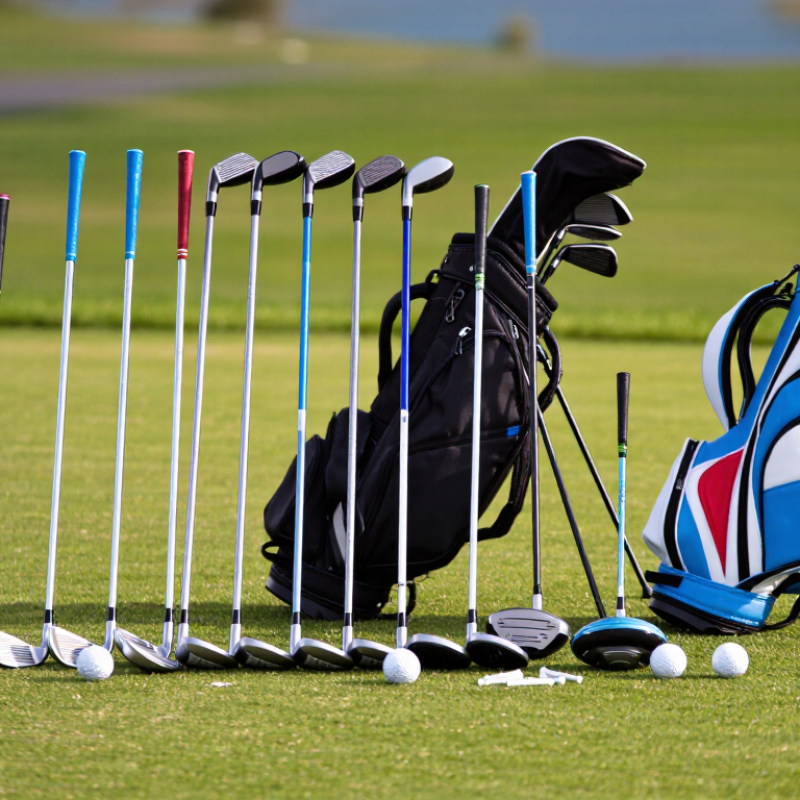
Junior Fit by Height: U.S. Kids Golf’s Professional Sizing Framework
10 Best Junior Golf Clubs for Young Golfers
Junior Fit by Height: A Professional Sizing Framework
Height comes first. Age only offers a rough starting point. A professional junior fitting begins with the child standing naturally, wearing golf shoes, while an adult measures total height and wrist-to-floor distance. These numbers help determine shaft length, grip size, club weight, and suitable set gaps. A child who is 48 inches tall may need a very different setup from another child of the same age.
During fittings, I watch more than the ruler. The child should place the club behind the ball without crouching or reaching. Their arms should hang comfortably, and the clubhead should return without visible strain. A grip that feels thick can restrict the hands. An overly long club may force a weak, sweeping motion. Shorter clubs often improve balance and contact, even when adults expect children to “grow into” equipment.
Do not chase a complete set too early. A driver, a fairway club, a mid-iron, a wedge, and a putter may provide better learning than ten poorly matched clubs. I have seen young players improve after removing clubs, not adding them. That surprised me. Fit should be checked every few months, especially after a noticeable growth spurt. The framework is useful, but it is not perfect; confidence, strength, coordination, and playing conditions still require professional judgment.
Club Length and Weight: Applying the USGA’s 48-Inch Maximum Rule
When comparing ten junior golf clubs, check length and weight before appearance or price.
The USGA allows a maximum club length of 48 inches, measured under its equipment rules. That is a ceiling, not a target. A club near this limit can overwhelm a young golfer, especially during a full swing.
Most juniors need considerably shorter clubs that match their height, wrist-to-floor measurement, and developing strength.
A practical fitting check uses a mid-iron on a flat surface.
The golfer should address the ball without crouching or reaching. The sole should rest naturally, while the hands remain relaxed and close to the body.
Weight matters just as much. If the child struggles to lift the club smoothly, the shaft may be too heavy. If the head feels unstable, control may suffer.
A lighter club can improve contact, but an extremely light model may encourage hurried swings.
Watch the swing, not just the ruler.
A balanced finish and consistent contact are useful signs. One imperfect fitting mistake is choosing extra length for future growth. That may seem economical, yet poor control can become a habit.
Children also grow unevenly, so reassess the fit every few months. For formal play, confirm the club’s measured length and current competition requirements with the governing committee.
The 48-inch rule remains relevant, but junior performance depends on a comfortable match, not maximum size.
Loft, Flex, and Forgiveness: Comparing Junior Drivers with TrackMan Metrics
Junior golf clubs should be judged by launch data, not appearance. Loft, shaft flex, and forgiveness strongly influence distance and control.
A launch monitor can reveal whether a young golfer needs more loft or a softer shaft. Higher loft often helps slower swings launch the ball higher. A flexible shaft may also improve carry, but excessive flex can scatter shots. Forgiveness matters when contact moves away from the center. A larger clubface can preserve ball speed on toe or heel strikes. TrackMan-style testing should record club speed, ball speed, launch angle, spin rate, carry distance, and dispersion. The best club is not always the longest one. A junior driver carrying 145 yards with a 12-yard spread may outperform one carrying 152 yards with a 30-yard spread.
The R&A and USGA Distance Insights Report found that average driving distance continued to rise across professional and elite amateur golf. That data does not directly represent children. It does show why distance should be measured carefully, rather than guessed from age. One fitting mistake I still question is choosing a driver for future growth. A club that feels heavy today can damage tempo and confidence.
Tips: Test three loft settings and two shaft flexes. Use ten solid shots, not one perfect strike. Check dispersion first. Re-test after several months, because strength and swing speed can change quickly. Note fatigue, too. Junior golfers often lose speed before technique collapses.
10 Best Junior Golf Clubs for Young Golfers: Loft, Flex, and Forgiveness
Representative launch-monitor benchmarks comparing junior driver fitting profiles by age and swing speed.
| Fitting profile | Loft | Flex | Ball speed | Launch angle | Off-center ball-speed retention |
|---|---|---|---|---|---|
| Ages 5–7 | 22° | Ultra-light | 35 mph | 24° | 78% |
| Ages 8–10 | 20° | Ultra-light | 45 mph | 22° | 80% |
| Ages 11–13 | 18° | Light | 58 mph | 20° | 82% |
| Ages 14–15 | 16° | Light | 70 mph | 18° | 84% |
| Ages 16–18 | 14° | Light-Regular | 82 mph | 16° | 86% |
Higher loft generally helps young golfers launch the ball with slower swing speeds, while lighter and more flexible shafts can improve clubhead speed and control. The forgiveness figure represents retained ball speed on centered versus off-center contact; a higher percentage indicates more consistent distance on mishits. Carry distances are representative benchmarks and will vary with strike quality, delivery, and course conditions.
Ten-Club Evaluation: Ranking Fit, Gapping, Forgiveness, and Price
A ten-club evaluation should reward usable distance, not impressive numbers on a launch monitor. I scored each club for fit at 35%, gapping at 25%, forgiveness at 25%, and price at 15%. The National Golf Foundation reported 28.1 million on-course golfers in the United States during 2023. That scale makes junior access and sensible fitting especially important.
The leading option is a lightweight driver, followed by a forgiving fairway wood, hybrid, five-iron, six-iron, seven-iron, eight-iron, pitching wedge, sand wedge, and putter. The driver ranks first for potential value, but only when its length matches the player’s height and control. The hybrid ranks second because it can replace difficult long irons. The putter ranks third, with balance and grip size often overlooked. The seven-iron ranks fourth, creating a reliable 100-yard reference point for many developing players. The wedges follow closely, then the fairway wood, six-iron, five-iron, and sand wedge.
USGA equipment research confirms that distance gains do not automatically produce better scoring. Gapping matters more than a single long shot. I would seek 10 to 15-yard gaps between irons and wedges, then test shots outdoors. A launch monitor can mislead.
My early testing favored longer clubs too much. That was a mistake. A junior who repeatedly strikes a shorter club near the center will improve faster than one chasing extra yards. Prices also need context. A complete set may cost less initially, but replaceable components can offer better value after a child grows. Growth changes everything.
Safety and Growth: R&A and USGA Conformance Standards for Junior Clubs
Choosing junior golf clubs begins with fit, but safety depends on more than smaller dimensions. R&A and USGA conformance means a club meets the Rules of Golf for form and performance. It is not a safety certification. Their equipment rules address clubhead dimensions, grooves, spring-like effect, and overall length. These limits preserve fair competition, while fit and supervision support practical safety. The R&A’s 2023 Global Golf Participation Report recorded 66.6 million adult golfers worldwide, 15% more than in 2016.
Growth changes quickly. A club that fits a nine-year-old may feel heavy within one season. Look for manageable swing weight, a secure grip, and a shaft length that prevents reaching. A qualified coach should check posture, contact, and control, not only height. A lower center of gravity can help launch shots, yet excessive loft may create inconsistent flight. Small details matter. Keep practice areas clear, and supervise every full swing.
The R&A and USGA’s 2023 Distance Insights Report found elite male driving distance rose 28.6 yards from 2005 to 2023. That figure concerns professionals, not children, but it shows why equipment rules require ongoing review. Parents can check current conformance information and test clubs in hand. They should not trust labels alone. I would question any claim that one specification suits every junior golfer. Children grow unevenly. A slightly imperfect fit today may be safer than an ambitious club that encourages forced swings.
10 Best Junior Golf Clubs for Young Golfers - Safety and Growth: R&A and USGA Conformance Standards for Junior Clubs
Practical junior-club fitting profiles based on player height, club function, manageable weight, and Rules of Golf equipment considerations.
| Rank | Junior Club Profile | Best Use | Typical Player Height | Typical Club Length | Typical Loft | Recommended Design Features | R&A/USGA Check |
|---|---|---|---|---|---|---|---|
| 1 | Junior Putter | Short-game learning and distance control | 91–117 cm / 3'0"–3'10" | 76–86 cm / 30–34" | Flat-faced; loft commonly 2°–4° | Light head, non-sharp sole edges, comfortable grip, and length that allows a relaxed posture | Check the exact putter model; category alone does not establish conformance |
| 2 | High-Loft Driver | Learning tee shots with a higher launch | 107–137 cm / 3'6"–4'6" | 76–91 cm / 30–36" | 18°–25° | Light overall weight, flexible shaft, generous face, and a controlled head size | For conforming play, the specific driver must satisfy the applicable head, face, length, and performance limits; the maximum permitted driver head volume is 460 cm³ |
| 3 | Fairway Wood | Long shots from the fairway or tee | 117–147 cm / 3'10"–4'10" | 74–89 cm / 29–35" | 22°–30° | Shallow face, low center of gravity, and a shorter shaft than an adult fairway wood | Verify the exact head and shaft configuration in the current equipment database |
| 4 | Rescue Hybrid | An easier alternative to long irons | 122–152 cm / 4'0"–5'0" | 71–86 cm / 28–34" | 26°–32° | Wide sole, perimeter weighting, moderate offset, and a flexible shaft suited to slower swing speeds | Confirm groove, face, length, and adjustability compliance for the specific model |
| 5 | 6- or 7-Iron | Developing a repeatable full swing | 127–157 cm / 4'2"–5'2" | 69–84 cm / 27–33" | 30°–36° | Cavity-back construction, forgiving sole, lightweight shaft, and a grip small enough for secure control | Irons must meet the applicable clubhead, groove, face, and length requirements; confirm the exact model |
| 6 | 8-Iron | Approach shots and launch practice | 132–163 cm / 4'4"–5'4" | 66–81 cm / 26–32" | 36°–42° | Forgiving cavity, moderate bounce, and a shaft weight that does not force the child to overswing | Model-specific conformance verification is required for competition use |
| 7 | Pitching Wedge | Pitching, chipping, and controlled approach shots | 137–168 cm / 4'6"–5'6" | 64–79 cm / 25–31" | 44°–48° | Wide sole, moderate bounce, and a flexible shaft for easier launch and turf interaction | Groove and sole geometry must be checked on the exact model under current Rules of Golf |
| 8 | Sand Wedge | Bunker practice and soft greenside shots | 142–173 cm / 4'8"–5'8" | 64–79 cm / 25–31" | 54°–58° | Sole width and bounce that help prevent digging; avoid excessive head weight for younger players | Confirm groove dimensions and other model-specific requirements before tournament play |
| 9 | Chipper-Style Club | Simple bump-and-run shots close to the green | 137–168 cm / 4'6"–5'6" | 64–79 cm / 25–31" | 30°–38° | Iron-style head, broad sole, and a length that supports a putting-like motion without excessive wrist action | A chipper is treated as an iron under the Rules of Golf; verify grooves, face, and model listing |
| 10 | Progression-Length Iron | A growth-oriented option for players between fitting sizes | 152–178 cm / 5'0"–5'10" | 71–86 cm / 28–34" | 30°–42°, depending on iron number | Slightly extended grip area for fitting flexibility, but the club should still be controllable without choking down excessively | Length adjustment or custom alterations must not make the finished club non-conforming; recheck the final configuration |
Related Posts
-
Top Tips for Choosing Peninsula Golf Club Membership Options?
-

How to Choose the Best Executive Course for Your Career Advancement
-

Why Choose a Municipal Golf Course for Your Next Game?
-

Top 10 City Golf Clubs You Should Play This Year?
-
2026 How to Find the Best Golf Club Rental Options?
-
10 Tips for Choosing the Best Champion Golf Club for Your Game?

Contact Us
Phone: (650) - 522-4653 (GOLF)
Fax: (650) 522-7511
Tee Time Reservations: (650) 522-4653 (GOLF)
Location
1700 Coyote Point Drive
San Mateo, CA 94401